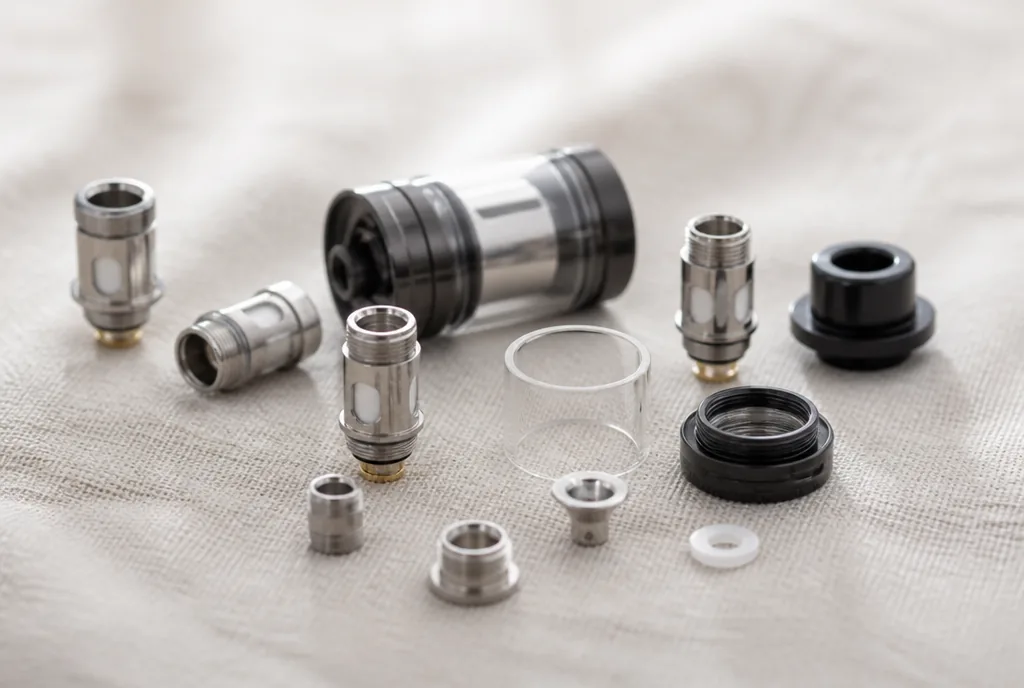
Coil calculator: the right number, not the proof
A coil calculator promises a figure in seconds: pick a wire, enter a mandrel size and a number of wraps, read a resistance in ohms. The maths itself is not the problem, because the maths is sound. The problem is what that number persuades a builder of, on screen, before the build has ever touched a cell.
What a coil calculator actually works out
A coil calculator applies Ohm’s law to the geometry of a length of resistance wire. It holds the electrical resistivity of the alloy you selected, works out how much wire the stated mandrel diameter and wrap count consume, and returns a theoretical resistance.
That is a physics calculation, not a guess. For a homogeneous wire, under ideal conditions, the formula gives a correct answer. The weight of the sentence sits on that one word: ideal.
No coil calculator measures the build you actually made. It works out what a build ought to read if the wire were perfectly pure, the mandrel perfectly calibrated and the wraps perfectly even. None of those three things is guaranteed on a workbench in a British living room.
The tool only concerns hand building in the first place. A factory coil such as one from the Geekvape Z series leaves the production line already calibrated, with its value printed on the packaging, and nobody needs a calculator to fit one.
The inputs that decide whether the result is usable
A coil calculator is worth exactly as much as the parameters you feed it. Three pieces of information move the output directly, and getting any one of them wrong is enough to make the whole figure meaningless.
The alloy comes first. Kanthal, nichrome, stainless steel: each has its own resistivity, and each behaves differently once heat enters the picture. Picking the wrong entry in the dropdown produces a number that is correct on paper and wrong on the deck, because the calculation rests on a metal that is not the one in your hands.
The mandrel diameter comes second. The figure you type has to match the rod you actually wrapped around, not a size recalled from memory. A few tenths of a millimetre change the length of wire consumed per wrap, and therefore the resistance at the end of it.
The wrap count comes third, and it is the one most often entered wrong. Wraps mean the active turns of wire, not the legs running out to the posts. Counting the legs in inflates the number you enter and quietly corrupts the result the screen gives back.
Why the calculated figure never matches the measured one
Even with every parameter entered correctly, the tool remains a model. The physical world introduces gaps the formula cannot anticipate, and those gaps are not academic.
Wire purity varies from batch to batch at most manufacturers, including the well regarded ones sold through British specialists. Two spools of the same nominal gauge, bought months apart, can carry slightly different resistivity with nothing on the label to say so.
The build itself matters just as much. Wraps that sit too tight or too loose, a mandrel pulled out with a slight twist in the wire, a leg clamped unevenly under a post screw: each of those details shifts the measured value away from the calculated one.
Contact points add their own parasitic resistance, unique to every single build. Wire crushed under a screw, surface oxidation on the metal, the state of the threads in the deck: none of that exists inside a coil calculator, and all of it exists on the atomiser once it is assembled.
The gap between calculated and measured is often small on a simple build. Small is not the same as irrelevant, and it weighs proportionally heavier the lower the resistance goes, which is exactly the territory where the consequences of being wrong are largest.
A coil calculator is never a substitute for an ohm reader
This is where this site takes a clear position. A coil calculator is a preparation tool, not a validation tool. Treating it as a safety check puts the person holding the device directly at risk.
The only value that counts before vaping a rebuildable is the one read off an ohm reader, or a dedicated resistance tester, on the finished coil in the finished atomiser. Not the figure the calculator printed before any wire was cut.
On a regulated mod, a reading outside the chipset’s accepted window normally triggers a software refusal, and the device simply will not fire. On a mechanical mod there is no electronics in the path at all, so nothing stands between a bad build and a current the cell was never designed to deliver.
That is where the continuous discharge rating of the cell enters the picture. The correct figure is the one published by the manufacturer of that exact cell, on that exact cell’s own datasheet, never a number quoted by a wrap or repeated in a forum thread. Compare it against the current implied by the measured resistance, after the measurement, never before it.
A cell pushed past its continuous rating heats abnormally, degrades quickly and becomes a direct hazard to the person carrying it. Reading the resistance before firing a mechanical mod is therefore not one precaution among several. It is the step that does the protecting.
That same measurement is also what catches a faulty build before it turns into a short circuit on the deck. A coil calculator can say nothing about a contact fault that does not yet exist at the moment it runs.
Why this article hands you no build to copy
A coil calculator knows nothing about the cell you are using, its state of wear, its true condition after a year in a pocket, or the accuracy of the mandrel you will actually hold. Publishing a build presented as safe would mean setting all of that aside for a comfortable number that is wrong the moment it leaves the page.
The useful question is never which figure to copy. It is which sequence to follow: accurate parameters into the calculator, a careful build, then a measurement before any use at all. The sequence protects. The number on step one does not.
The same discipline covers the boring parts of ownership that nobody photographs. Married cells only, an intact wrap with no nicks or tears, a hard plastic case for any loose cell in a bag or pocket, and a charger designed for the chemistry in question. A device that refuses to start is telling you something, and forcing it is never the answer.
Frequently asked questions
Is a coil calculator reliable for someone new to rebuildables?
It is genuinely useful for planning a build and understanding how wire, diameter and wrap count interact. It never removes the need to read the finished coil on an ohm reader before firing it.
Why does the measured resistance differ from the calculated one?
Because the calculator assumes perfectly pure wire and a perfectly even build. In practice, metal purity, wrap tightness and the quality of the contact points always move the final value slightly.
Should I use one for a build going onto a mechanical mod?
It can help you plan, but a mechanical mod has no electronics protecting anyone. The measurement before use becomes the only check that counts, and it has to happen before the device is ever fired.
Which cell rating should I pick for a build I have planned?
No generic answer belongs here. The requirement follows from the resistance you actually measured and from the continuous discharge rating printed on that specific cell’s datasheet, in that order and never the reverse.
Do these tools handle series and parallel builds?
Some offer the option once you state the number of wires, but the principle does not change. The output stays theoretical, and a multi wire build makes the measurement step more critical, not less, because of what it does to the current drawn.
Coil calculator: a starting point, never a verdict
A coil calculator does real work. It stops you guessing blindly at wrap counts or mandrel sizes when you are aiming at a target resistance, and it makes the relationship between the variables visible in a way that trial and error never will. That service is real, and it is confined to the planning stage.
The gap between theory and reality never fully closes, however carefully the parameters are entered. That is why reading the finished build on an ohm reader is not an optional extra bolted on out of excessive caution, but the step that gives everything the tool produced upstream its actual value.
Understanding that limit changes how the whole of rebuildable vaping reads. Less a hunt for the perfect figure, more a method that ties planning, a careful build and a systematic check together before every single use. A coil calculator earns its place inside that method, and loses all meaning outside it.
Editorial content for adult readers only. Vaping products usually contain nicotine, a substance that causes addiction. Not for sale to under-18s in the United Kingdom. This article is not a buying recommendation and does not replace an actual resistance check before use.
Also on the site
Coil shorted: the one error message that reassures
Coil shorted reports a safety cut that worked, not a broken device. Our view on a badly named message that hides two completely different faults.
Vape coil: one word, two very different products
The words vape coil once meant a wound length of wire. On British shelves they now mean a sealed cartridge, and that drift costs the buyer money.
Geekvape Z coils: the range put under scrutiny
Which reference to choose, which fitments genuinely hold, and where the range contradicts itself. Our argued pick among the Geekvape Z coils.