Coil shorted: the one error message that reassures
Nobody enjoys a screen that refuses to fire. Yet across the whole family of atomiser warnings, coil shorted is the one that ought to be greeted with a degree of relief. It does not report a broken device. It reports a device doing precisely what it was paid to do. The problem is not what the mod did. The problem is what it says about it.
Coil shorted: what the device has actually just done
British retailers translate the message plainly enough: the atomiser is short circuited, and the mod has dropped into a protective state that blocks any further use until the fault is cleared.
Concretely, the chipset has detected an abnormal continuity between the two poles and cut the supply before sending current down that path. It has not found a faulty part. It has found a circuit it refuses to feed.
That is the fundamental difference with the no reading warning, which we pull apart in our critique of the coil not detected message. There, nothing gets through at all. Here, something gets through far too easily.
Why this message deserves better than its reputation
A vaper who sees this screen learns two things in a second. The first is that a fault exists. The second, considerably more important, is that the chain of protection worked from end to end.
That distinction does not exist everywhere. A mechanical mod carries no chipset at all, whereas a regulated mod meters the power it sends and flags a malfunction when it finds one. On the first kind, the identical fault produces no message whatsoever and no refusal to fire.
It is the strongest argument in favour of regulated electronics for anyone who has not internalised Ohm’s law, and it is almost never framed that way in British shops. An error message is a service rendered, not an inconvenience.
One label, two opposite faults
This is where the judgement hardens. Under a single wording, the specialist sources describe two distinct electrical situations that call for neither the same action nor the same diagnosis.
The first is a direct contact between the poles. On a rebuildable, a coil leg touching the wall of the deck creates a short, which is why the standard advice is to check that the build sits clear and the post screws are properly done up. A badly made build putting positive and negative in contact does exactly the same thing.
The corrective action there is mechanical: strip it down, move the offending part clear, reassemble carefully. No purchase is involved, and a build redone properly clears the warning.
The second situation is not a short circuit in any strict sense. If the resistance is below the window the mod is able to work with, the device blocks because it cannot deliver power into that load safely, and the answer is a coil higher up the range rather than a spanner.
Here the assembly is sound, the part is healthy, and no amount of dismantling will change anything. The corrective action is a purchase, and it is the exact opposite of the previous one.
Showing the same sentence for both situations asks the user to guess which one they are living through. A chipset that knows the measured value and knows its own accepted window could simply say so. None of them do, anywhere in this product category.
The fix that repairs is also the fix that breaks
The next paradox sits in two published pieces of advice, and it deserves flagging because it traps the most conscientious owners rather than the careless ones.
Shops recommend unscrewing the atomiser, cleaning the connection pin and the threads, then screwing it back down neither too tight nor too loose, until you feel slight resistance. Others explain that a connection pin pushed too far in, which is what happens when a tank is screwed down hard, causes precisely this type of fault and has to be eased back out.
In other words, the most widespread reflex faced with a coil shorted screen, which is to nip it up a little tighter, is also the documented cause of the next problem. Nobody warns the user about that loop, and no manual anywhere defines what slight resistance is supposed to feel like in the hand.
Wear markers that are worth almost nothing
Since the coil itself sits among the possible causes, it would help to know when to replace it. On that ground the trade offers only approximations, and they contradict each other.
One common marker is visual: cotton that has gone slightly yellow is still usable, cotton that has gone brown is finished. It is workable, but it requires dismantling the tank and it depends heavily on how darkly coloured the liquid was in the first place.
The service lives quoted vary wildly from one British retailer to the next, from a few days to a month or more, and none of those intervals is tied to a volume of liquid vaporised. That is the only unit that would allow any comparison at all.
The result is that replacement gets decided on feel, so usually too late and occasionally far too early. Our analysis of what the word coil actually covers returns to that missing unit of measurement, which is not specific to short circuits.
What a good coil shorted message would say
The complaint only has value if it comes with a proposal. Four pieces of information, all of them already inside the device, would transform this screen entirely.
The measured value at the moment of refusal, so a direct contact can be told apart from a coil sitting under the accepted window. The window itself, printed alongside, so the gap reads instantly. An explicit line stating that the cut is deliberate and the device is undamaged. And a separate wording for the out of range case, instead of a label shared with a genuine short.
None of that requires an extra component. The chipset already measures, the screen already displays. What is missing is an editorial decision by the manufacturer, and that is exactly what makes the omission fair game.
The same reasoning applies to the habits around the hardware itself. Married cells only in a dual battery mod, an intact wrap with no nicks, a hard case for any loose cell in a bag, a charger matched to the chemistry, and never forcing a device that refuses to start. A refusal is information, not an obstacle.
Frequently asked questions
Can the battery be the culprit rather than the coil?
It happens. Owners occasionally report the fault clearing after swapping a removable cell. It stays a minority case but it is worth ruling out before replacing a tank.
Does the message appear under other wordings?
Yes. Atomizer short is the most widespread phrasing on British screens, and several brands use an abbreviated label specific to their own interface, which does not help anybody.
Can a leak trigger it?
E-liquid that has worked its way into the device from a leaking tank sits among the documented causes. Cleaning the connection and replacing the seals then becomes part of the diagnosis.
How do I tell whether the fault is the tank or the mod?
Fit the tank onto a different mod. If it fires normally there, the connection pin on the first device is the suspect. If it does not, the tank is.
Do some e-liquids gunk up a coil faster?
Heavily flavoured liquids, particularly dessert and tobacco profiles, along with some home mixing concentrates, are widely described as harder on a coil than plain profiles.
Reading a coil shorted screen for what it really is
Not many everyday objects announce their own protective shutdown. On that specific point, regulated vaping hardware does better than it is usually credited for, and the irritation this screen provokes is wildly out of proportion to what it means.
What can fairly be held against the industry is not that it fitted the protection. It is that it named it badly. As long as coil shorted covers both a stray contact and a value outside the accepted window, owners will keep trying both remedies at random, and they will generally start with the wrong one.
The same lesson runs through the planning stage of any hand built setup, where the figure on screen is never the figure that matters. Our piece on what a coil calculator can and cannot prove makes the case that a measurement, taken before anything is powered, is the only step that genuinely protects the person holding the device.
Editorial content for adult readers only. Vaping products usually contain nicotine, a substance that causes addiction. Not for sale to under-18s in the United Kingdom. This article is not a buying recommendation and does not replace an actual resistance check before use.
Also on the site
Coil calculator: the right number, not the proof
A coil calculator returns a theoretical resistance. What it cannot see, and why the ohm reader stays the only figure worth trusting before you vape. Points of viewVape coil: one word, two very different products
The words vape coil once meant a wound length of wire. On British shelves they now mean a sealed cartridge, and that drift costs the buyer money.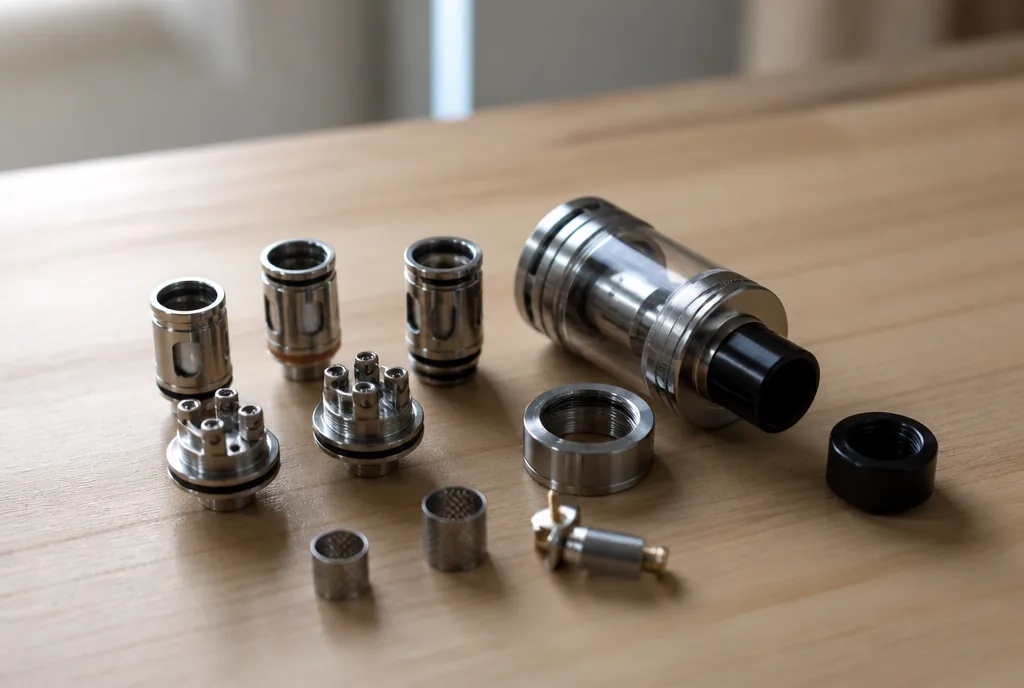
Geekvape Z coils: the range put under scrutiny
Which reference to choose, which fitments genuinely hold, and where the range contradicts itself. Our argued pick among the Geekvape Z coils.