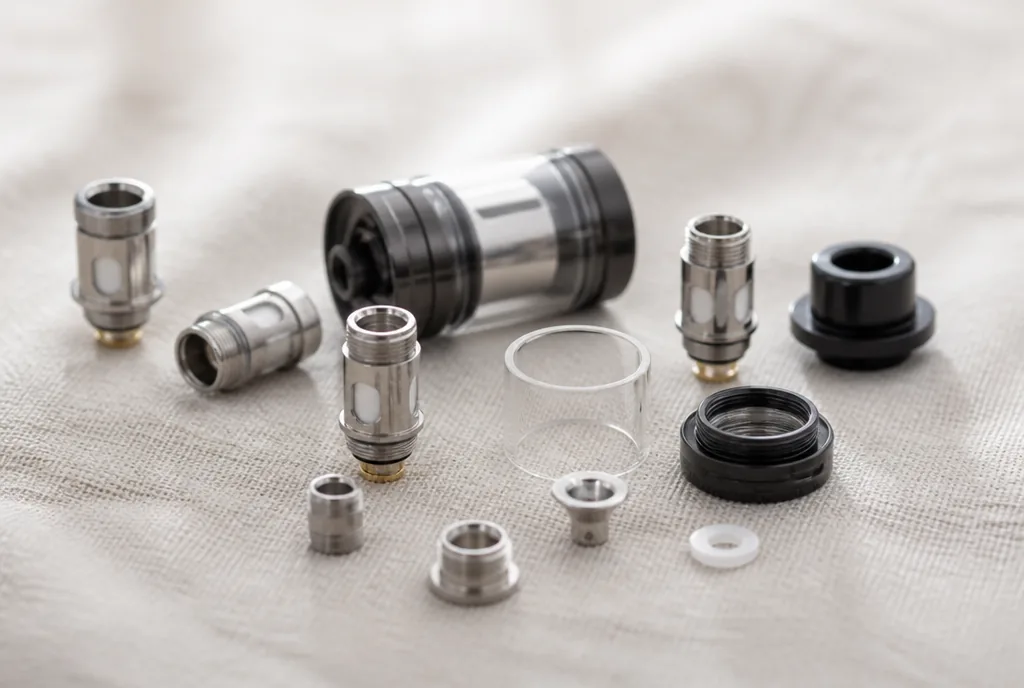
Vape coil: one word, two very different products
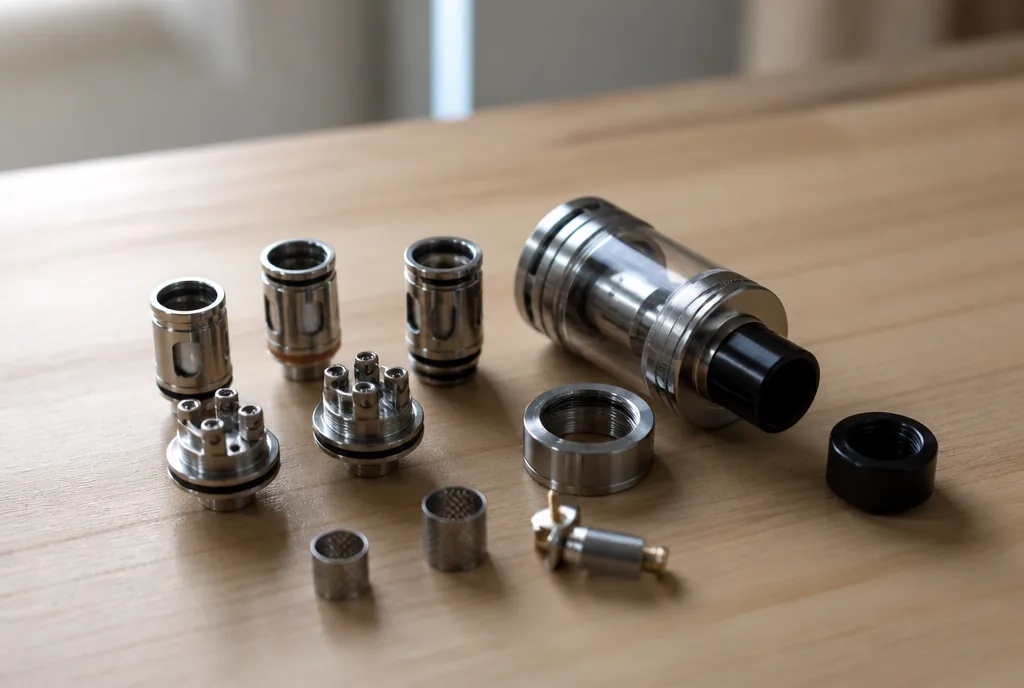
One word, two objects that share neither price, nor lifespan, nor purpose. Searching for a vape coil in Britain leads, depending on which page opens, to a bare loop of metal wire sold in bulk boxes, or to a sealed plastic part sold in packs of three or five. The trade let that ambiguity settle in, and it works rather well for whoever sells the second kind.
What the words vape coil originally described
The definition has never been in dispute among the people who bother to write it down. A coil is a wound length of resistance wire whose only job is to heat up and turn e-liquid into vapour. That is the whole of it.
British retailer glossaries still say as much when they describe the heating element that takes power from the battery and vaporises the liquid. In that original sense the word points at one precise object: a conductor, wound, and nothing else.
What the word does not describe, in that sense, is the cotton around it, the chamber holding it, the seals isolating it or the plastic body carrying the lot. Yet all of that is what most people now buy under the name.
From a loop of wire to a sealed cartridge
The drift is visible in the way catalogues are organised, with no need to ask anyone. Two entirely separate aisles use the same word for two products that have almost nothing in common.
Among retailers who serve the rebuildable crowd, the word stays faithful to its meaning. Premade coils sit in the resistance wire section, sold in tins by the dozen, described as prebuilt clapton, fused or alien builds in kanthal or stainless steel. Forty of them fit in a matchbox.
Everywhere else, the same word serves as a trade name for a completely assembled part. Replacement coil sections on the big British shops list sealed units for Geekvape, Innokin, Smok, Vaporesso and the rest, and the wire inside is one component among five or six.
The right word did exist. Coil head was the term reserved for the interchangeable units that drop into a tank, as opposed to coil on its own, kept for what a builder makes by hand. That second word, head, has quietly fallen off the labels.
Its disappearance is not an innocent simplification. Head was the syllable carrying the entire difference between an assembled part and a bare component, and nothing replaced it.
The result is a two speed vocabulary. Someone hunting for a vape coil can land on an item costing pennies each in a tin of forty, or on a consumable renewed every fortnight, with no lexical signal at all to warn them which aisle they are standing in.
Why the drift is not a neutral piece of marketing
Renaming a complete cartridge after its cheapest component has a measurable effect on how the price reads. The buyer believes they are paying for wire. They are mostly paying for assembly.
Inside a factory coil, the part that fails first is almost never the metal. It is the cotton, saturated with residue from sweeteners and colourings, that ruins the taste long before the wire gives up. The rest of the unit, body, seals, chamber, goes in the bin in perfect condition.
The vocabulary therefore hides exactly what the consumer would benefit from seeing: a composite object thrown away because one of its elements reached the end of its life. No product listing presents it that way, and the loose use of the word does not help.
British shelves add a wrinkle of their own. Refillable tanks sold here are capped at two millilitres, and nicotine containing e-liquid at ten millilitre bottles, which pushes higher powered users towards larger nicotine free shortfills topped with nicotine shots. It also means the tank is emptied and refilled constantly, and the cotton inside gets a harder life than the marketing copy suggests.
Materials, the one piece of information that stayed honest
On one point at least the vocabulary has not drifted. The alloys still carry the same names, and those names still mean something concrete.
Kanthal remains the most common alloy in factory mesh, including in the best known British ranges. Nichrome and stainless steel turn up in the thicker builds sold for higher powered use, and the two behave differently as they heat.
That stability has a practical consequence, and it works as a rule. A kanthal element belongs in variable wattage or variable voltage use only. A nickel or titanium element belongs exclusively in temperature control. A stainless steel element works either way.
In other words, the material decides what mode the device may run in, before the resistance printed on the box tells you anything. It is the one line on a product listing that forbids or permits something outright, and it is usually the one set in the smallest type.
There is a final irony worth naming. Most interchangeable units today are not made from wound wire at all but from a perforated metal strip, the mesh that every British listing now advertises. Applied to current hardware, the words vape coil usually describe an object that is no longer a coil in any literal sense.
What the product listings still refuse to tell you
A consumable is judged on its cost in use, not on its shelf price. The information that would make that calculation possible is almost universally missing.
No factory coil listing states the mass of cotton inside, the length of wire used, or an expected service life expressed in millilitres of liquid vaporised. Retailers fall back on symptoms noticed after the fact: flavour drops off, liquid starts creeping up the chimney, then the taste turns burnt.
That is the substantive complaint to put to this industry. A sector selling a consumable replaced every couple of weeks ought to publish a unit of measurement for its lifespan, as other consumable industries have done for decades. It does not, and the fog around the word makes the absence less visible.
The three words that keep you in the right aisle
Three terms are enough to clear the ambiguity at the moment of purchase, and the better British retailers already use all three correctly.
Resistance wire, or bare coil, means the wound element alone, to be fitted by hand onto a rebuildable deck. Factory coil, replacement coil or cartridge means the sealed assembly of wire, cotton and body that pushes or screws into a tank. Coil used alone in a brand’s own marketing should be read as a trade name and checked before anything reaches a basket.
That reflex avoids the most expensive mistake on the shelf, which is buying a pack of five incompatible units because the product name looked familiar. Our look at the Geekvape Z range shows how far one appellation can stretch across references that are not interchangeable at all.
Frequently asked questions
Are coil and resistance exactly the same thing?
In everyday trade language, yes. Strictly, coil names the heating element while resistance names both that element and the whole part containing it, which is where the confusion starts.
Is mesh a coil?
Mesh is a perforated metal strip, not a wound wire. It does the same job but does not match the literal definition, which is why the word has effectively lost its original meaning.
Are bare coils really cheaper?
Per unit, yes, since premade builds are sold by the dozen. Cotton, tools and the time spent building all get added to the calculation afterwards, and that is rarely mentioned.
Why do brands invent names for their coils?
A proprietary name makes the consumable identifiable and ties it to a range. It also encourages repeat purchase, since the part can no longer be swapped for a generic reference.
Does the number of heating elements change anything?
A unit with two elements spreads the power and heats faster, at the cost of a higher liquid consumption. The resistance printed on the box alone does not let you predict that.
Reading a vape coil label properly
The word has not finished drifting, and no authority exists to stabilise it. What remains verifiable sits in three pieces of data that any serious listing publishes: the resistance, the material, and the list of devices it fits.
Those three markers place any product sold as a vape coil on the map, whether it is a bare wound element for a rebuildable deck or a sealed cartridge for a tank. More importantly, they let a buyer compare like with like, which is precisely what the trade name no longer permits.
The same three checks explain most of the mishaps that end up on British forums, including the sealed unit that a device refuses to read at all. Our critique of the error message that follows, and our review of the Lost Vape UB range, both come back to a naming problem rather than a manufacturing one.
Editorial content for adult readers only. Vaping products usually contain nicotine, a substance that causes addiction. Not for sale to under-18s in the United Kingdom. This article is not a buying recommendation.
Also on the site
No coil detected: a badly written error message
No coil detected asserts a cause where the device only has a symptom. Our argued critique of how British vape hardware writes its error screens.
Coil calculator: the right number, not the proof
A coil calculator returns a theoretical resistance. What it cannot see, and why the ohm reader stays the only figure worth trusting before you vape. Points of viewGeekvape Z coils: the range put under scrutiny
Which reference to choose, which fitments genuinely hold, and where the range contradicts itself. Our argued pick among the Geekvape Z coils.