No coil detected: a badly written error message
Three English words on a screen the size of a stamp, and an owner unscrewing a perfectly good tank while the actual fault sits somewhere else entirely. The no coil detected message is probably the worst written sentence in consumer vaping hardware. It is not technically a lie, but it points at the wrong part, in the wrong order, for a cost that is not the right one.
What the mod sees when it shows no coil detected
The device’s actual finding is electrical, not physical. The chipset tries to measure the circuit connected to its terminal and gets no usable reading back, which retailers describe as the device failing to detect the presence of a coil in the atomiser.
That failure to read can come from a missing coil, certainly. It can equally come from an interrupted contact, a value outside the window the chipset accepts, or simple grime on the threads. British shop guides routinely list a poor connection between coil and battery first, ahead of a missing part.
In other words, the screen prints a conclusion where the device only holds a symptom. That shortcut is the whole of the problem, and everything that follows from it flows downhill.
A message that asserts a cause instead of describing a reading
The difference sounds subtle. It is not. Coil not read states a measured fact. No coil detected implicitly states that no coil is present, which is false in the great majority of real cases.
A user reads a sentence and acts on it. If the device says it cannot find a coil, they check the coil, then they replace the coil. They do not spontaneously think to clean a connection pin, ease off a tank that has been screwed down too hard, or verify that the part they bought sits inside the range their mod accepts.
Retailer troubleshooting pages list, among the possible causes, a worn coil but also a wrong reference or a resistance outside the accepted window. Two of those three are not solved by buying another of the same part. They are solved by buying a compatible one, which is a different bill entirely.
Four labels, and no coil detected is only one of them
The second complaint is a collective one. Manufacturers never agreed their vocabulary, so each one names the same situation in its own way.
British retailers group Check Atomizer, No Atomizer and this message together as three phrasings meaning the mod cannot read a coil. Others publish a single article covering No Atomizer, Check Ato and Atomizer Low in one go, because customers arrive with all four and the same underlying problem.
When shops are obliged to write translation articles to make the screens of the products they resell legible, the editorial work was not done upstream. The owner has to work out which family their message belongs to before they can even begin looking for a fix.
Atomizer Low deserves separating out, because it does not describe the same thing at all. There, the value is read, but judged too low to be powered safely. Filing it alongside this message in one troubleshooting article maintains the confusion rather than lifting it, and our analysis of the short circuit warning deals with that second family properly.
The real cost: a troubleshooting order back to front
A well written error message ranks the actions. This one does the exact opposite, and the difference shows up on a bank statement.
The most frequent causes quoted by British sellers are a failed connection, a coil not pushed or screwed fully home, and a dirty contact. All three are fixed in a minute at no cost. The expensive cause, replacing the consumable, comes statistically after those free checks in every published list.
The message, meanwhile, puts the consumable in the very first word. The outcome is predictable: brand new coils binned because they were never seated to the stop, and owners convinced the whole pack was defective.
Two different fitting methods make the misunderstanding worse. Some coils push in by pressure, as on several pod systems, and others screw in, as on many tanks. The right action for one is the wrong action for the other, and the screen draws no distinction whatsoever between them.
There is a hardware fault that produces the identical symptom, too. A connection pin that has worked loose from its rubber seat can trap the positive leg of the mesh and stop the mod reading anything at all, a defect documented on customer reviews of the Lost Vape UB range among others. That is a faulty part, not user error, and the screen sends the owner looking in the wrong direction.
The blind spot: the documentation is not where you look for it
Here is the observation that seems the most damning, and it is verifiable in one search. On the first page of British results for this phrase, the positions are held by forum threads, retailer blogs, a social media group, a video tutorial and even foreign language shop pages.
Not a single mod manufacturer appears. The content explaining a message displayed by a device is therefore produced entirely by the people who sell it, never by the people who programmed it.
A printed manual runs to a few pages and gets lost. A web page of error codes, maintained by the brand, would cost close to nothing and would remove half of the problem. The sector chose to leave the load with retailers, who carry it rather well, but it is not their job.
The consequence is visible to the naked eye: public sources contradict each other. Some state flatly that coil wear has nothing to do with this message, others list a damaged or defective coil among their main causes, and others again describe resistance wire deteriorating and breaking after several weeks of use.
Three serious pages, three different positions on the most expensive cause. None of them is wrong in the absolute, because none of them has access to the reference document that would settle it. That is precisely what an absent manufacturer documentation produces.
What a better error message would show
The complaint would be unfair if no proposal followed it. The chipsets already hold everything needed to do better than this.
The measured value, or an explicit statement that no reading was obtained, instead of a conclusion. The window the device accepts, displayed at the moment of refusal, so an incompatible part can be told from a defective one. One label per condition across a single brand, rather than three depending on the generation of chip. And a pointer to an error code reference published by the manufacturer.
Nothing in that list is a technical feat. The measurement is already taken, the window is already known, the screen is already there. What is missing is not electronics. It is writing.
Frequently asked questions
Does the message always appear in English?
On the overwhelming majority of mods, yes, including models distributed across Europe. Multilingual menus remain the exception in this product category.
Can a mod without a screen report the same thing?
It signals it by flashing an indicator light, with a code that varies from model to model. The information exists, but it is even harder to read than a line of text.
Can this appear on a pod system?
Yes, as soon as the device carries a chip that reads the circuit. The exact wording then depends on whichever firmware the brand loaded.
Should I suspect the battery?
Reading the value does not depend on charge level as long as the device powers up at all. A flat battery produces its own separate warnings.
The message returns after cleaning, what does that mean?
An immediate return after a cleaned contact points at the connector itself, or at a compatibility problem with the value, rather than at simple grime.
What no coil detected should really mean
An error message is not a cosmetic detail. It is the only interface between a chip that knows exactly what is happening and a person who does not. On that ground, consumer vaping hardware lags behind almost every other category of domestic electronics sold in Britain.
As long as no coil detected is written as a conclusion, it will keep sending owners towards the most expensive part before the free checks. The right reaction is to read the screen for what it actually is, a failure to read the circuit, and to start at the connector every time.
The deeper issue is the one that runs under most complaints about this hardware, which is a vocabulary nobody controls. Our piece on what the word coil now covers shows how far that drift has gone, and why a message written around the word was always going to mislead.
Editorial content for adult readers only. Vaping products usually contain nicotine, a substance that causes addiction. Not for sale to under-18s in the United Kingdom. This article is not a buying recommendation.
Also on the site
Vape coil: one word, two very different products
The words vape coil once meant a wound length of wire. On British shelves they now mean a sealed cartridge, and that drift costs the buyer money.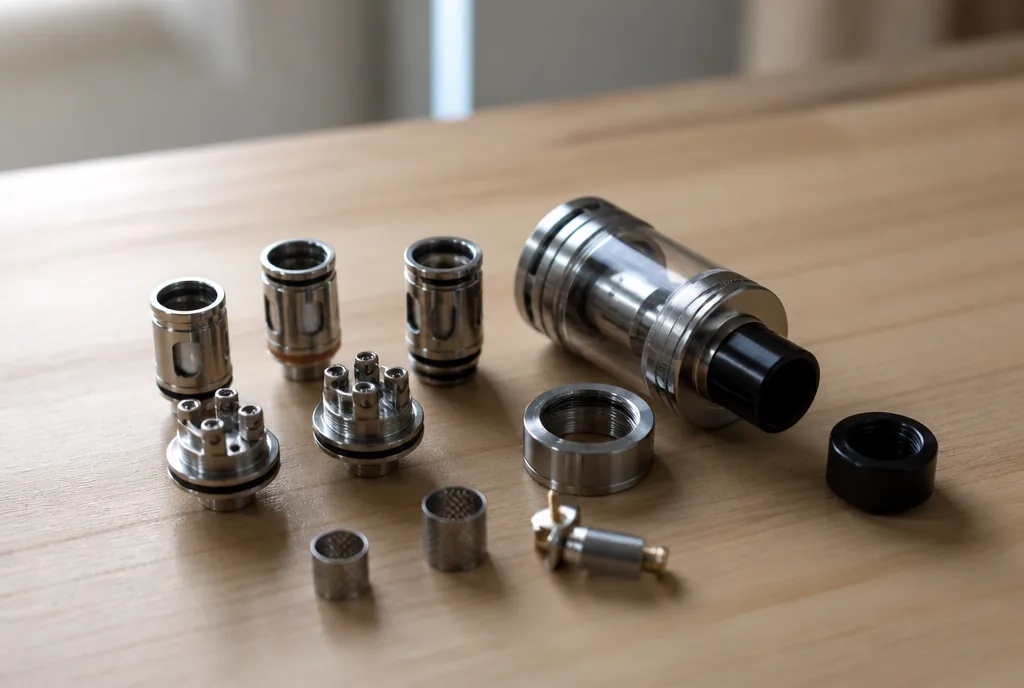
Coil calculator: the right number, not the proof
A coil calculator returns a theoretical resistance. What it cannot see, and why the ohm reader stays the only figure worth trusting before you vape. Points of viewGeekvape Z coils: the range put under scrutiny
Which reference to choose, which fitments genuinely hold, and where the range contradicts itself. Our argued pick among the Geekvape Z coils.